
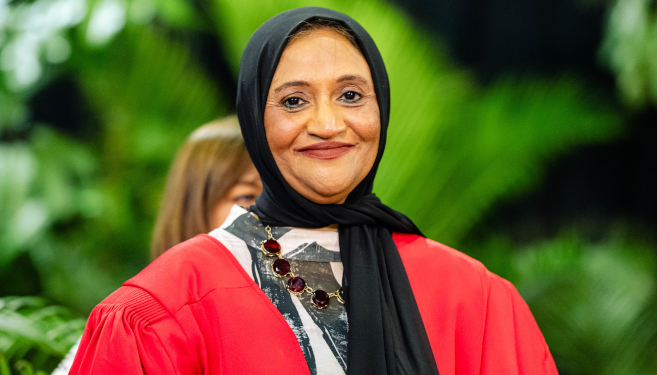
The University of KwaZulu-Natal (UKZN) celebrates the graduation of Dr Nasim Banu Khan, who was recently awarded a PhD in Audiology. Her doctoral research produced a novel tool aimed at strengthening early hearing detection and intervention (EHDI) services in South Africa.
Supervised by Dr Lavanithum Joseph (Neethie), Khan’s research was titled: ‘The Development of a High-risk Stratified Checklist for Primary Healthcare Nurses for Screening and Monitoring of Hearing Loss in Infants at Community Level in KwaZulu-Natal, South Africa.’
Her study addressed a critical gap in South Africa’s health system. While global guidelines advocate for universal newborn hearing screening (UNHS), this has not yet been fully implemented in South Africa. Khan instead developed a context-specific, evidence-based checklist that equips primary healthcare nurses to identify infants most at risk for hearing loss – particularly during routine immunisation visits.
“The checklist highlights risk factors such as maternal infections, extended Neonatal Intensive Care Unit stays, family history of hearing loss, jaundice, meningitis, and ototoxic medication use,” explained Khan. “Importantly, these risk factors interact and must be monitored collectively. This tool acts as a safety net for missed cases, giving children the chance for earlier diagnosis and support.”
Her research drew on a wide range of perspectives, including primary healthcare nurses, healthcare professionals, audiologists, and mothers of children at schools for the Deaf. It also included an analysis of more than 1 400 audiology records. Findings showed that 65% of children with hearing loss presented with one or two identifiable risk factors. By tailoring screening to South African conditions, the study provides a practical solution that could significantly improve child health outcomes in resource-limited settings.
Khan said: “I feel extremely proud and fulfilled. This work is more than just academia, it has the potential to directly impact children’s lives. Hearing is foundational to language, communication, and learning, and ensuring earlier identification and intervention can change the trajectory of a child’s future.”
Born and raised in KwaZulu-Natal, Khan spent many years working for the provincial Department of Health before joining UKZN as a lecturer in Audiology. Her frontline experience exposed her to the challenges families face when hearing loss is detected late, fuelling her passion for preventative audiology and public health.
She credits her family, colleagues, and supervisor for their unwavering support during her PhD journey. “My supervisor fostered a nurturing and caring ethos, encouraging me to think critically and work rigorously. My family’s encouragement kept me grounded, and the thought of helping children was my greatest motivation.”
Outside of academia, Khan enjoys reading, spending time with family and friends, and engaging in community outreach initiatives that promote health education and early detection. She has presented her work at local and international conferences and has published from her PhD, ensuring that the voices of nurses, caregivers, and communities are represented on peer-reviewed platforms.
Khan is committed to advancing paediatric hearing healthcare in South Africa. “This research is only the beginning. My hope is that the checklist will be widely adopted and integrated into primary healthcare systems, ensuring that no child with hearing loss is left unidentified,” she said.