
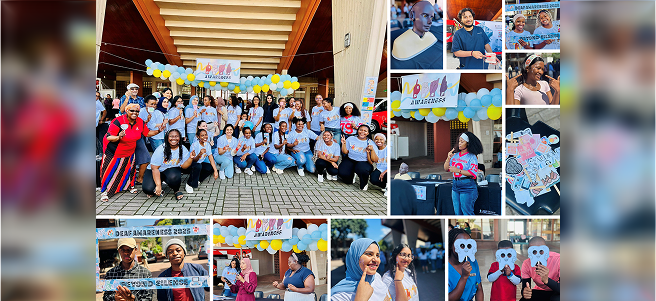
‘Beyond the Silence’ was the theme chosen by this year’s final-year Audiology students. On Deaf Awareness Day in September – commemorated globally as the International Month for Deaf People – they encouraged the UKZN community to discover more about Deaf culture, communication and inclusivity. They also lobbied for all South Africans to learn sign language – recently declared an official language – as a way of bridging communication gaps caused by deafness and rising numbers of hearing loss.
‘Let’s talk. Let’s listen. Let’s create awareness’. This motto captured the day’s objective. Through fun-filled games, prizes, in-person engagements, and face painting by Bobo the Clown at the Westville Campus Quad, the students offered free screening as part of the Aural Rehabilitation Clinic.
Mr Nevil Balikrishna from the Disability Support Unit, explained that the Unit provides support for students with disabilities and advocates for the recognition of their rights within the University’s living and learning spaces. He noted that UKZN has admitted students with disabilities for many years. The University graduated its first sign language user in 2021, its first postgraduate student in 2022, and currently has eight sign language users enrolled.
Balikrishna said: “The success of a sign language user in Higher Education is determined by extensive support which comes from note-takers, the country’s sign language interpreters, disability practitioners, as well as funding through the National Student Financial Aid Scheme.” He said that while it would cost approximately R1.2 million to successfully graduate a Deaf student at the undergraduate level, equating that value for the greater benefit of society was immeasurable.”
Balikrishna noted that of South Africa’s five million hard-of-hearing population, 600 000 were sign language users. “The global prevalence is 1.5 billion, and the World Health Organization has 2050 estimates of 5 billion, which will require extensive capacitation of public health services, especially for rehabilitation services. If countries do not address the challenges that come with hearing loss, it is estimated that the cost per annum will be 1 trillion USD, which is why early intervention is critical.”
Balikrishna was supported by Audiology lecturer, Mr Mukovhe Phanguphangu, who promoted regular hearing screening and emphasised the need to screen new-born babies for hearing impairments in order for early interventions to kick in and avoid hearing loss. He said that the lack of hearing affected cognition and lifelong opportunities.
Deaf third-year Drama and Performance Studies student, Ms Okuhle Msithwa, delivered an inspirational talk about the importance of learning sign language. She reminded attendees that anyone could lose their hearing at any time, and therefore all citizens should know at least the basics of sign language.
Highlighting the importance of Deaf education, Mrs Nomathemba Ndlovu, Principal of KwaVulindlela School of the Deaf, stressed that it is essential to learn and master sign language. She explained that their school educates hard-of-hearing learners and learners with autism – some with speech, others without. “Deafness is not only hereditary, it can also be acquired through ageing, being involved in an accident or disease,” she said.
Ndlovu described sign language as engaging and important, but like mathematics, it must be practised regularly to avoid being forgotten. She proudly shared that the school had employed its first Deaf educator, Ms Khadeejah Hansrod, who recently graduated with a Bachelor of Education in Foundation Phase Teaching, placed third nationally in South African Sign Language, and ranked second among learners in special schools in KwaZulu-Natal.
Audiology alumna, Ms Noorjehaan Kader Basha, now in private practice, emphasised the importance of early identification and intervention, especially for new-born babies. She explained that there are 7.5 million children under five with disabling hearing loss worldwide, and research shows that hearing loss at this age often goes unnoticed. “Babies learn language by listening and interacting from birth. Hearing loss can impair language, speech, cognition, and social development. Early screening allows for immediate intervention, leading to better outcomes.”
She illustrated this with a case study of a Grade 3 learner diagnosed with bilateral sensorineural hearing loss. “After receiving hearing aids and rehabilitation, her academic performance improved dramatically – achieving A’s and B’s within months. This shows how vital adequate hearing is for reaching one’s full potential,” she said.
Noorjehaan cautioned that hearing loss was not easily recognisable. “Most people are so impatient, they just assume the person with hearing loss is being rude or slow-witted. It is our responsibility to move beyond the silence.”
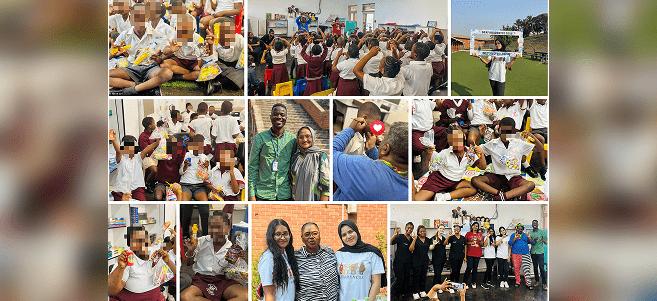
Final-year Audiology student, Ms Naasihah Ismail, said she loved and enjoyed engaging in Deaf awareness initiatives. “The smiles we brought to the children’s faces at the VN Naik School for the Deaf, where a few of us did our clinical rotation in the first semester of this year, were priceless and meaningful. We also get to share our passion with the rest of the UKZN students through the main event today.”
The event was supported by Bobo the Clown, the international humanitarian organisation Ashraful Aid, and the Al Imdaad Foundation, which provided meals. Anonymous sponsors contributed prizes, gifts, and refreshments. UKZN’s Dentistry and Oral Hygiene students also joined, accompanied by the Colgate mobile van, where they conducted screenings and referred clients to King Dinuzulu Hospital Complex.
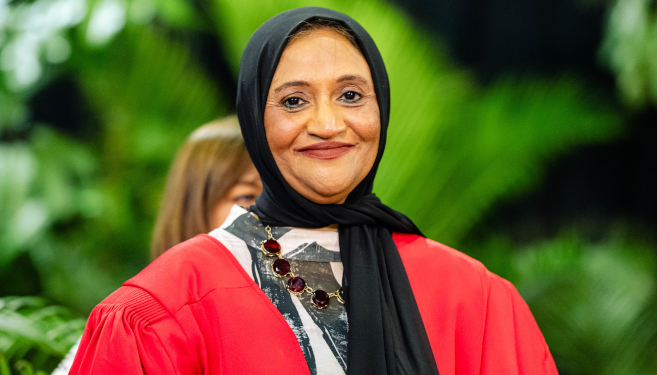
Audiology senior lecturer, Dr Neethie Joseph, described deafness as the opposite of hearing and highlighted community engagement, practical experience, and balance between the two as key drivers of the student-led campaign. She confirmed that UKZN offers a semester course in South African Sign Language (SASL), taught by a Deaf Sign Language Instructor.